

JMC Integrated Servo Motors (iHSV / iHSVC)
The iHSV series combines a brushless servo motor, encoder and servo controller in a single compact housing. The result: high speeds up to 5200 rpm, a torque that stays almost constant across a wide speed range, and very high dynamics – without a separate driver cabinet and with minimal wiring. Available from 52 W (NEMA17) to 660 W (NEMA34), optionally with holding brake for vertical axes. The version with holding brake carries the suffix “-SC”.
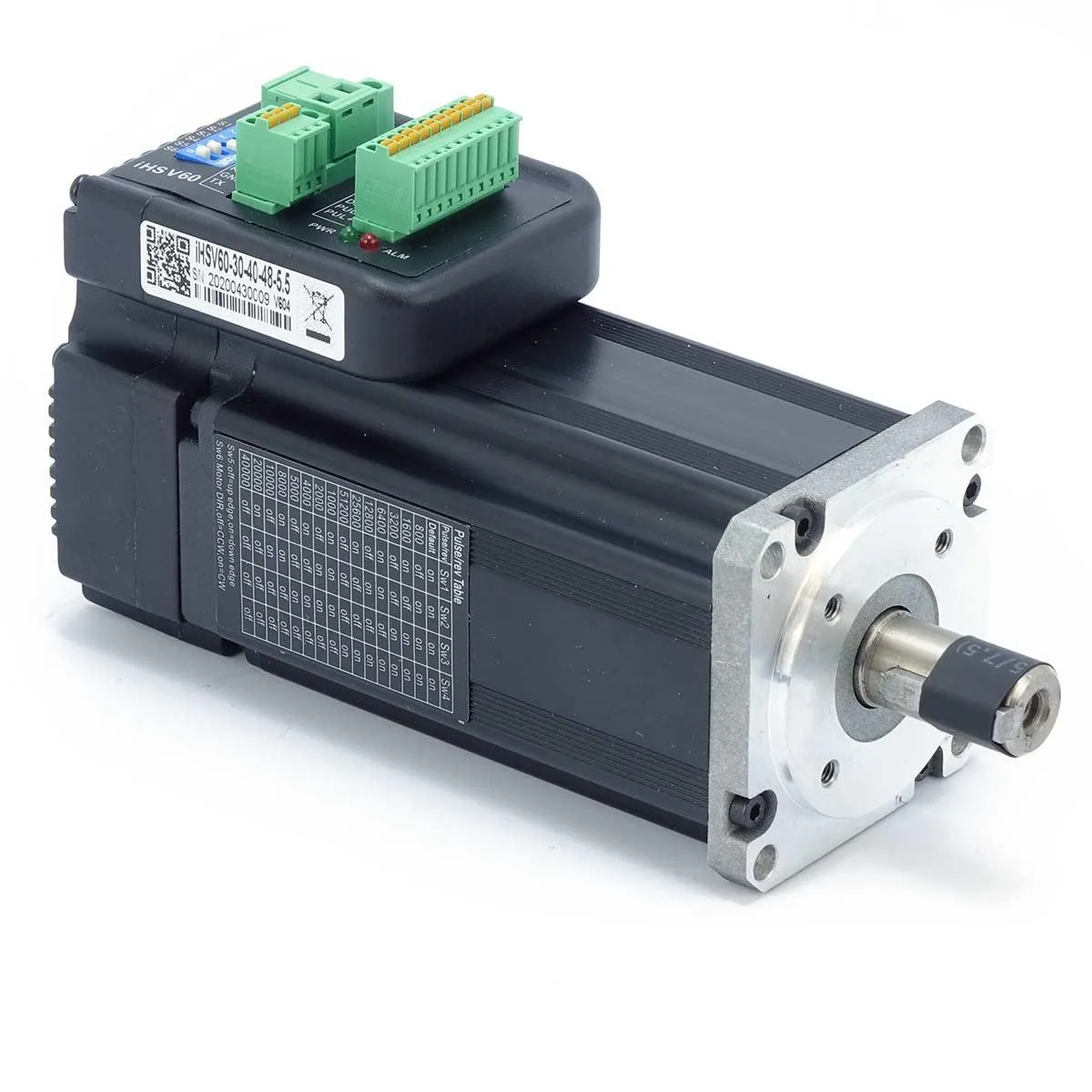
The Essentials at a Glance
An integrated servo motor continuously controls its position via an encoder and never loses steps. It spins high, accelerates strongly and maintains its torque even as speed rises – ideal for fast, dynamic or continuously loaded machines. With JMC, the servo controller sits directly inside the motor, so no separate servo amplifier in the control cabinet is needed. You only connect the supply voltage and the step/dir signal from your CNC controller.
Comparison Table: all JMC Servo Motors
Filter by frame size, voltage or brake to quickly find the right model. A click on “Buy” takes you straight to the article in the shop.
| Model | Size | Flange | Shaft Ø | Shaft len. | Pilot | Brake | Power | Nm cont. | Nm peak | rpm nom. | rpm max | A nom. | A max | V nom. | V max | |
|---|---|---|---|---|---|---|---|---|---|---|---|---|---|---|---|---|
| iHSVC42-40-05-24 | NEMA17 | 42×42 mm | 5 mm | 24 mm | 25.0 mm | No | 52 W | 0.125 | 0.19 | 3000 | 5200 | 3.4 A | 4.5 A | 24 V | 50 V | Buy |
| iHSVC42-40-07-24 | NEMA17 | 42×42 mm | 5 mm | 24 mm | 25.0 mm | No | 72 W | 0.185 | 0.275 | 3000 | 5200 | 5.1 A | 6.0 A | 24 V | 50 V | Buy |
| iHSVC57-30-10-36-21-38 | NEMA23 | 57×57 mm | 8 mm | 30 mm | 38.1 mm | No | 100 W | 0.29 | 0.44 | 3000 | 4200 | 3.5 A | 7.2 A | 36 V | 50 V | Buy |
| iHSVC57-30-14-36-21-38 | NEMA23 | 57×57 mm | 8 mm | 30 mm | 38.1 mm | No | 140 W | 0.44 | 0.67 | 3000 | 4200 | 5.4 A | 10.8 A | 36 V | 50 V | Buy |
| iHSVC57-30-18-36-21-38 | NEMA23 | 57×57 mm | 8 mm | 30 mm | 38.1 mm | No | 180 W | 0.57 | 0.9 | 3000 | 4200 | 7.5 A | 15.0 A | 36 V | 50 V | Buy |
| iHSVC57-30-18-36-21-38-SC | NEMA23 | 57×57 mm | 8 mm | 30 mm | 38.1 mm | Yes | 180 W | 0.57 | 0.9 | 3000 | 4200 | 7.5 A | 15.0 A | 36 V | 50 V | Buy |
| iHSVC60-30-20-36 | NEMA24 | 60×60 mm | 14 mm | 30 mm | 50.0 mm | No | 200 W | 0.65 | 0.95 | 3000 | 4200 | 8.5 A | 15.0 A | 36 V | 60 V | Buy |
| iHSVC60-30-40-48-5.5 | NEMA24 | 60×60 mm | 14 mm | 30 mm | 50.0 mm | No | 400 W | 1.27 | 1.9 | 3000 | 4200 | 11.2 A | 22.4 A | 48 V | 60 V | Buy |
| iHSVC60-30-40-48-5.5-SC | NEMA24 | 60×60 mm | 14 mm | 30 mm | 50.0 mm | Yes | 400 W | 1.27 | 1.9 | 3000 | 4200 | 11.2 A | 22.4 A | 48 V | 60 V | Buy |
| iHSVC86-30-44-48 | NEMA34 | 86×86 mm | 14 mm | 38 mm | 73.0 mm | No | 440 W | 1.4 | 2.1 | 3000 | 4200 | 13.1 A | 26.2 A | 48 V | 53 V | Buy |
| iHSVC86-30-66-72 | NEMA34 | 86×86 mm | 14 mm | 38 mm | 73.0 mm | No | 660 W | 2.1 | 3.0 | 3000 | 4200 | 13.1 A | 26.2 A | 72 V | 79 V | Buy |
| iHSVC86-30-66-72-SC | NEMA34 | 86×86 mm | 14 mm | 38 mm | 73.0 mm | Yes | 660 W | 2.1 | 3.0 | 3000 | 4200 | 13.1 A | 26.2 A | 72 V | 79 V | Buy |
All figures according to the manufacturer’s datasheet. “cont.” = continuous torque, “peak” = short-term peak torque. The “-SC” at the end of the model name indicates the version with integrated holding brake.
How the Integrated Servo Drive Works
At its core a brushless synchronous motor (BLDC) operates, whose rotor position is permanently captured by a high-resolution encoder. The integrated servo controller continuously compares the measured actual position with the target position it receives as a step/dir signal from the CNC controller. On any deviation – for example a load spike during milling – it adjusts the motor current in real time and actively holds the shaft in position. Unlike a classic stepper motor, the servo does not “latch” into fixed step positions but is continuously controlled. This produces smooth, powerful running up to high speeds, high efficiency and protection against step losses even under sudden load.
Torque Across the Speed Range
A key advantage over the stepper motor: while the stepper’s torque drops significantly as speed rises, the servo motor maintains its torque across a much wider range. With JMC the nominal speed is 3000 rpm, the maximum speed depending on frame size 4200 to 5200 rpm. This makes high rapid-traverse speeds possible without the axis losing force. The higher supply voltage of the larger models (up to 72 V) additionally supports torque at high speed.
Why “Integrated” Is a Real Advantage
Because controller and motor form a single unit, the separate servo amplifier together with elaborate motor and encoder wiring in the control cabinet is eliminated. This saves space, reduces wiring-related sources of error and significantly lowers system costs. Especially in DIY builds and machine retrofits this is a decisive practical advantage.
Control & Connection
The servo motors are controlled via a 5 V step/dir signal – exactly like a stepper motor driver. This makes them compatible with almost any common CNC controller, including Estlcam terminal adapters, Eding CNC, CSMIO and Beamicon-based systems. Per axis a pulse (step) and direction (dir) signal are transmitted; an additional enable signal releases the power stage. Via an alarm signal the motor can report a fault back to the controller.
For the power supply each motor needs its nominal voltage (24 / 36 / 48 / 72 V). The power supply should deliver the combined current of the simultaneously accelerating axes with reserve. Since decelerating servo motors feed energy back into the power supply, a charge capacitor module is recommended to absorb these voltage spikes and protect both the power supply and the motor electronics. Our RJ45 adapter sets simplify the clean wiring of multiple motors. Details on the page Wiring & Commissioning.
Parameterisation via RS232
Many parameters – such as current control, gain or input filter – can be adjusted via the RS232 interface. As delivered, the motors are already configured for practical use and usually run without further adjustment. For fine-tuning a USB-RS232 converter and the matching cable are required.
Typical Applications
The iHSV servo motors play to their strengths wherever speed, dynamics or constant performance are required:
Fast Gantry and Table Routers
On long axes with high rapid traverses the servo ensures short travel times without torque loss. Especially when machining wood, plastic and aluminium, where fast feed rates determine productivity.
Plasma and Laser Cutting Systems
Clean contours require constant path speed and fast direction changes. The high dynamics and the step-loss-free encoder control of the servos deliver precise, even cuts here.
Lathes and Feed Drives
For feed and spindle axes on lathe conversions, the NEMA24 and NEMA34 models provide the necessary torque combined with high speed.
Automation, Handling & Special-Purpose Machines
In pick-and-place, dosing and handling systems the high acceleration and maximum speed shorten cycle times. The compact form factor and the simple step/dir connection ease integration into special-purpose machines and test rigs.
More practical examples can be found on the page Application examples.
Which Servo Motor Fits My Machine?
The required power depends on machine weight, feed forces and mechanics. As a rough guide: small engraving machines manage with NEMA17 (52–72 W), medium gantry routers with NEMA23/24 (100–400 W), large or heavy machines with NEMA34 (440–660 W). For vertical Z axes the version with holding brake (“-SC”) is recommended so that the axis does not drop on power failure. A structured decision aid is provided by the selection guide.
JMC Servo Motors from Stock
All models, matching power supplies, charge capacitors, connectors and cables ready to ship in the shop.
View all servo motors in the shop For comparison: closed-loop stepper motors